
This comes at a time when competition has increased significantly.

Which is the best home loan? Advice from financial guru Harsh Roongta.

India's biggest non-bank finance company, Bajaj Finance (BAF), is set to raise capital after a gap of four years. On October 5, the board of directors will meet to approve the fund raise by way of preferential issue and/or qualified institutional placement (QIP) subject to regulatory and shareholder approvals. The move, analysts said, comes ahead of expectations, and could be in the wake of simmering competition in the consumer lending space, especially with the launch of Jio Financial Services (Jio Fin). "While we still do not have finer details on the game-plan of Jio Financial, it has plans to initially foray into consumer and merchant lending.

From FY18, Ind-AS will be mandatory for all listed entities, barring those listed on the SME platform.

'I suggest a cut in the GST rates and an infusion of Rs 1.2 trillion into the economy in six months.'

Banks will also consider requests from MSMEs for restructuring their stressed standard assets. So far, only 25 per cent of the around 1 million eligible MSMEs have taken benefit of the RBI's special dispensation.

Discussion paper fixes Rs 1,000 cr as minimum capital for these specialised banks

The Reserve Bank of India's (RBI's) latest order on unsecured loans is set to hit the banking sector's growth in the near-term, cautioned analysts, as they see banks slowing down on aggressive retail lending. Besides, cost of funds for non-banking finance companies (NBFC) is expected to inch up as banks will pass on higher capital charge to NBFCs. "We believe the fallout of the RBI action will be mainly on growth, given the rising dependence on unsecured retail loans and lending to NBFCs for growth.

Tamal Bandyopadhyay, columnist and author of several books like From Lehman to Demonetisation: A Decade of Disruptions and Sahara: The Untold Story, tells Rediff.com why Yes Bank depositors should not panic and the current crisis at India's fifth largest private lender does not pose any systemic risk.

The disruptions caused by COVID-19 have more severely impacted small and mid-sized corporates, including NBFCs and MFIs, in terms of access to liquidity.

After the hit of the pandemic, India Inc is now worried about the adverse impact of inflation and higher commodity prices on their revenues and margins. The inflation scare is the strongest among manufacturers of consumer goods such as automobiles, consumer durables, and fast-moving capital goods (FMCG). Companies across sectors fear they will not be able to pass on the hike in input costs to their consumers due to weak demand, which, in turn, would lead to a hit on margins and profitability in the forthcoming quarters.

India's corporate sector is likely to report a slowdown in revenue growth and earnings for the July-September 2023 period (Q2FY24), according to earnings estimates by brokerages, after the country's top listed companies posted higher than expected profits for the first quarter. The combined net profit of Nifty50 companies, based on brokerage estimates, is expected to have grown by 19.6 per cent year-on-year (Y-o-Y) to Rs 1.75 trillion in Q2FY24 - a sharp deceleration from 37.6 per cent Y-o-Y growth in the combined earnings of index companies in the April-June 2023 period. According to estimates, the combined earnings in the second quarter would be down 8.8 per cent on a quarter-on-quarter (Q-o-Q) basis and the lowest in the past three quarters.

RBI's licensing norms require a bank to bring down promoter holding to 40 % within 3 years of operation - which, for Bandhan Bank, will be by Aug 23

Former RBI governors Urjit Patel and Raghuram Rajan have also expressed worry about the Mudra scheme, particularly government's target-setting practice and the rising bad loans.

The RBI governor's assurance should give investors enough confidence to start believing in the NBFC sector again, say bankers.

Raamdeo Agrawal, joint managing director at Motilal Oswal Financial Services, tells Sheetal Agarwal key trends in this earnings season and investment themes in Indian markets.

Brokerages expect Nifty50 companies to have cumulatively witnessed strong double-digit growth in their earnings in the first quarter of FY24 (Q1FY24). This growth in the combined earnings is expected to have been driven by banks, automakers, and oil & gas companies. Other sectors may report muted profit growth.

It may be a 'no-go' for banking licences to large industrial houses.

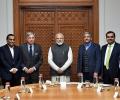
Further stimulus measures are expected in the upcoming Budget where the focus is likely to be on reforms, including some structural measures such as reducing red tape and boosting foreign direct investment. The meeting with industrialists is in the series of discussions that Modi has had during the last couple of weeks to seek suggestions to revive growth.

The most important positive of India's stealth bull market is earnings growth across different sectors, explains Debashis Basu.

The committee's suggestion that existing commercial banks be allowed to hold payment banks as subsidiaries is also seen as unviable by RBI and the finance ministry.

Existing bank deposits will continue with past rates until renewed on maturity.

A few days back, Finance Minister Nirmala Sitharaman urged the start-up community and public to deal in cryptocurrency with caution because everything that was floating around was not currency. In the first week of August, the country's top nine crypto exchange platforms were summoned by the Directorate of Enforcement (ED) in Hyderabad. The exchanges were questioned for money laundering, especially over a number of Indian non-banking financial companies and their fintech partners for predatory lending practices in violation of the Reserve Bank of India (RBI) guidelines and by using tele-callers who misuse personal data and use abusive language to extort high interest rates from the loan takers.

With more and more youngsters preferring to shop online, the credit appetite has surged.

Corporate indebtedness is now twice what it was before the global financial crisis; banks' bad loans ratio is 3.5 times higher.
While start-ups are making it easier to borrow, one needs to choose carefully.

'If businesses are focused on de-leveraging, they can hardly be investing. This is the price extracted by investment mistakes during UPA rule, and should have been foreseen. 'But Modi-I must share the blame, for muted reform of the financial sector, partisan policy in telecom, the harm done to exports by an over-priced rupee, and so on,' says T N Ninan.

Bandhan financial Services will raise funds via internal accruals.
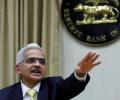
'The banking sector appears to be on course to recovery,' declares the RBI governor.

Gadkari said, infrastructure sector including highways, airports, inland waterways, railways, logistic parks, broad gauge and metro, apart from MSMEs can attract large scale foreign investment.
India's top listed companies reported their best-ever quarterly net profit of Rs 2.39 trillion in the September quarter of FY22, up 46.4 per cent year-on-year. The earnings were driven by a big surge in the profitability of banks, non-banking financial companies & insurance (BFSI), oil & gas, and metal & mining firms. The combined net profit of these three cyclical sectors were up 87 per cent YoY to a record high of Rs 1.53 trillion, up from Rs 82,000 crore a year ago and Rs 1.08 trillion in Q1FY22.

Diversified business conglomerate Mahindra and Mahindra (M&M) has picked up a 3.53 per cent stake in private sector lender RBL Bank for Rs. 417 crore. "We may consider further investment, subject to pricing, regulatory approvals, and required procedures. However, in no circumstance will it exceed 9.9 per cent," M&M said in an exchange notification on Wednesday. Shares of RBL Bank jumped 7.1 per cent to settle at Rs. 238.8 apiece on the BSE on Wednesday, close to their 52-week high of Rs. 242.1.

'One of the ways to do that is to ensure that NBFCs have got liquidity.' 'If we don't do that, this mood of gloom will continue.' NBFCs need to be provided with liquidity if they have to start lending.

With at least three IPOs in the offing this year, stock market investors have a lot to look forward to.

Auto-debit payment bounces have gone up for the second consecutive month in May, emphasising the stress building up due to a halt in economic activities as authorities lock down various parts of the country to stop the spread of the virus in the second wave. According to the National Automated Clearing House (NACH) data, in May, of the 85.7 million transactions initiated, 35.91 per cent, or 30.8 million transactions, failed.

For the first time in our economic history a government has thought about more than 50 per cent of our economic activity instead of the five per cent represented by the Sensex companies, observes IIM-B professor R Vaidyanathan.

Why can't we have a sunset clause for the ARCs, which is a global norm? questions Tamal Bandyopadhyay.

According to Fitch rupee is expected to weaken to 72 to a dollar by the end of December 2019, and further to 73 by December 2020, from 69.82 to a dollar in end December 2018.

Stocks such as ICICI Bank, Axis Bank, State Bank of India, Bank of Baroda and HDFC Bank are among the top banking picks of analysts for 2017. A decline in cost of funds and treasury gains are expected to help stabilise their net interest margins
